Skip to the posts
Buffalo's neighborhood journals since 2003 🍀 Patrick Spicy Devil Logan🌭 Sahlen🥨 Weber Spank🥟 Pierogi🐸 Scaj🍺 Labatt Utica Pink Cherio❄️ Snow Murder

tinypliny’s journal

🏷️ science

54 posts

Cancer Progress Report.

·

A very well written comprehensive progress report on where we stand in cancer research and what we know currently in the war against cancer was released by the American Association of Cancer Research a couple days ago.

I think this report is well worth reading, if only to know a little more about this terrible disease. The plainly laid out facts in the report challenge the ill-founded conspiracy theories about how the medical, research and pharmaceutical establishments are out to get the cancer patient and are suppressing the cure to cancer (See for example: @vincent #55175)

If you had any questions about cancer or simply wished you had a better understanding of the disease, I highly recommend this read:
::READ PDF::

Science on organic foods: what needs to be done.

·

Attached is the article I linked in my comment to @paul #55115. It reviews the state of science that is investigating if organic foods are really as good for people as many believe. It outlines the limitations of current studies and lays down some guidelines for how future studies might address this question better.

Intervention studies are the gold standard for evidence. Population studies generate statistically tenable hypothesis. :)

@heidi, this PDF is for you.

::READ PDF::

Counterfactual thought

·

I think @paul was wondering how businesses actually make money from Groupon...

From:


What is missing in the typical narrative about Groupon – the one promoted by the company – is the “counterfactual”. The counterfactual is a powerful concept embedded in statistical theory. In order to evaluate the data in front of us, we must imagine an alternative world (the counterfactual) in which we allow the data to present themselves differently. To understand how medicine X might affect you, you can't just measure what happened after you took medicine X; you must also consider what might have happened if you took medicine Y and/or nothing at all.

So, instead of just thinking about the new customers brought in by Groupon, we must also consider the world without Groupon. In the world without Groupon, the regulars pay $100 for their meals, and the new customers pay $0 or some other amount (if Giorgio’s has other ways to attract them). This allows us to realize that the insertion of Groupon into that world would lower the intake from regulars while simultaneously raising the intake from new customers. For the merchant, whether Groupon is a net benefit depends on the balance between those two numbers.

This is related to the concept of opportunity cost in economics. When evaluating the value of an investment, we can’t just tally up the returns of said investment; we have to compare those returns to the returns of doing something else such as keeping the money in the bank.


Information is beautiful

·

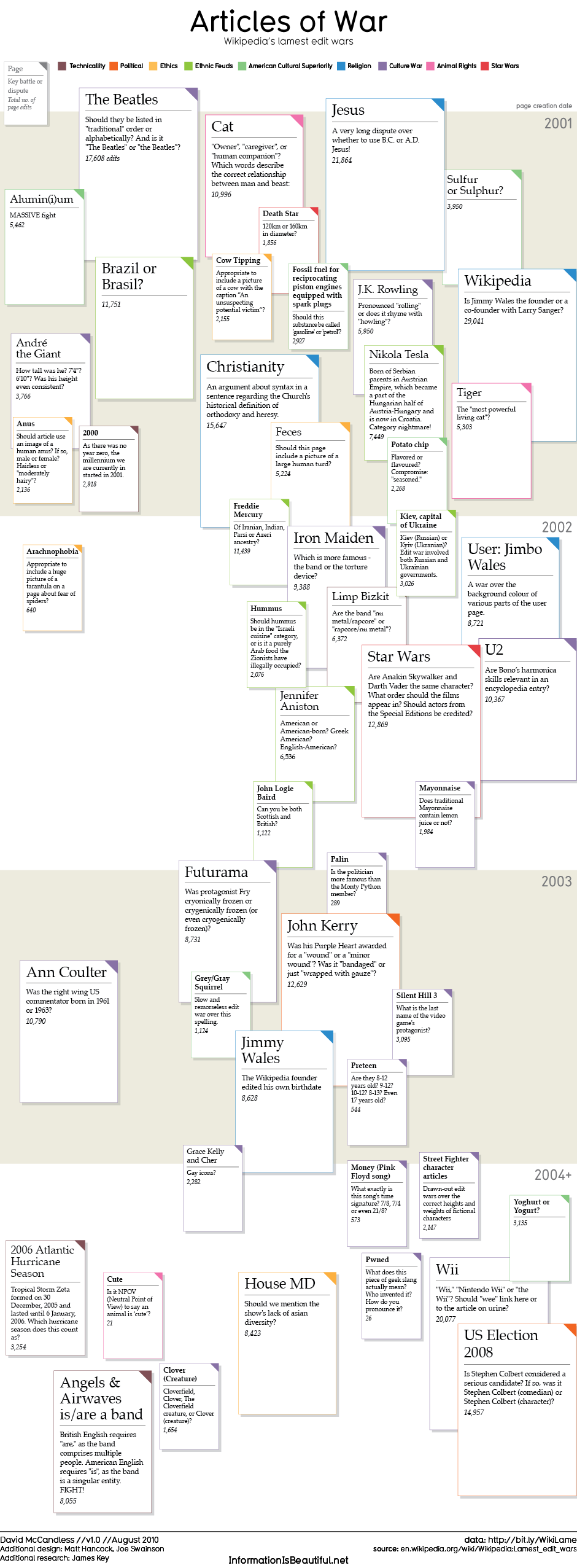
Or not.
image
From:
Some of those edit wars may sound so ridiculous, but what I really can't believe right now is I was involved in a particularly intense one not long back and almost got banned. Nopes, totally not telling which one. That identity and IP of mine are thankfully buried forever. ;-)

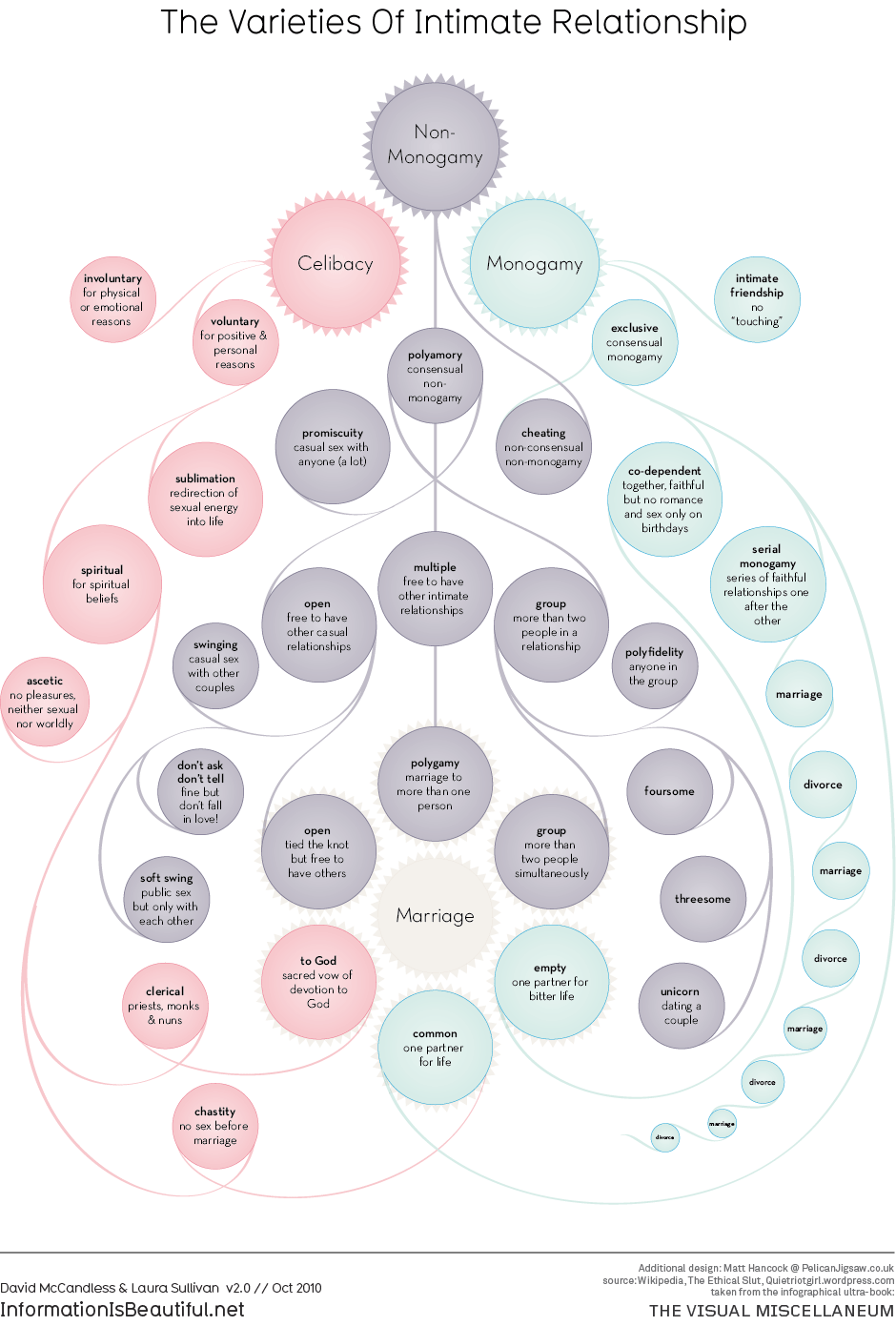
And I have to say, I love that term "Sublimation". Makes singledom sound way cooler. haha
image
From

Google actually increases our IQ

·

I took a break and read some fun studies that came out this week in Science (pdfs below). A professor at Columbia conducted some experiments about how our memories operate in the presence and absence of assured information sources online such as Google and Wikipedia.

She found, not surprisingly, that our priorities have moved not towards memorizing trivia but towards more efficient ways to retrieve this trivia from where it might be stored online. And since remembering trivia is a relatively easier task than remembering techniques and algorithms to retrieve this trivia, our IQs are actually getting sharper as technologies progress and our environments become richer with information.

As @paul said to me not long ago, Google has pretty much become everyone's mother. And we are constantly thinking of ways to jog her memory and get relevant information out.

Science is an interesting magazine/journal. For people in academia, publishing in Science and Nature are the pinnacle of achievement. But somehow, a large number of studies from humanities and behavioural sciences which do get published in these journals (Science way more than Nature) seem to get away with the simplest of experiments, approaches and super-obvious hypotheses. More arduous basic and clinical science that takes a ton of effort to perform gets rejected routinely.

I often wonder if we, as basic and clinical scientists, place undue importance to getting published in these so-called lofty journals, and agonize too much about where we get published. After all, some of the finest nobel-winning impact-making science was not published in these journals but obscure journals with lowly impact factors when they first came out. (It's another matter however that these "lowly journals" have since become really prominent and elitist.)

Academia is a funny twisted world.
---
Refs:
::READ PDF::
::READ PDF::

Wash your produce well!!

·

A mass scale epidemiological investigation into the German e.coli outbreak spread over the past few weeks FINALLY identified organically grown bean sprouts as the source of the offending e.coli strain. People who ate these sprouts were nine times as likely to develop bloody diarrhoea when compared with people who didn't. From:

After wild allegations against the whole Spanish salad produce industry, the unmasking of the organically grown sprouts as the culprits comes as a bit of a eye-opener about the health risks of organic farming. Are we really sure that the human and animal refuse used as fertilizers in organic farms do not leave behind cysts and eggs of sundry virulent bacteria and parasites? Do we always make sure that we wash our produce well before eating it raw?

In the past, I have been guilty of trusting apparently fresh-looking greens and produce too much and eating them after a cursory wash. However it pays by the spadefuls to remember that cysts/eggs are hardy and can survive mild non-abrasive washing. It is up to us to make sure that our food sources are not contaminated.. and even if they are, that we do the utmost that we can to prevent superficial parasitic and bacterial cysts and eggs from entering our system.

Birdsong and microRNA.

·

I was recently reading an article about how birdsong influences the expression of small RNAs called... microRNA that in turn, influences gene expression.

It's absolutely fascinating. If you think about it, everything happens with gene-expression. Every little sound or image or any sensory input we receive from outside changes and temper the way our genes express in an ever-changing interaction.

I wonder what an intense episode of stress does to our immune-system related genes... Does it promote allergic reactions? Does it suppress the immune-system in a counter-productive move? I have this slight inkling of a doubt that this year, my escalating stress, nightmares about graduating and complete lack of restful sleep day in and day out is probably the primary cause of all my out-of-the-blue allergies.

I have never had allergies to ANYthing before. I usually cope with stress well... but then I have also had family around me in the past to buffer most extreme stressful times. I have sailed through most 40 hour shifts with nothing more than sore throats in the past. But I think if I had to do those shifts now, I would fall seriously sick. Things have changed so much.

So coming back to microRNAs, I wonder how microRNA influenced gene-expression charts the course of body physiology and especially, immune-system function. Sounds like an excellent future avenue ripe for investigation - especially since we can knock some of these microRNAs out with drugs...

Claritin Vs. Benedryl: Mechanism of Action

·

@paul, @terry and I were discussing the relative merits of Claritin (Loratadine) in comparison with Benedryl (Diphenhydramine) in combating symptoms of allergy. Apart from remembering that Benedryl is a 1st generation antihistamine and that Loratadine is a 2nd generation antihistamine, I was sorry to note that I remembered nothing more about their pharmacology or specifics of how they differed from each other in their mechanism of action.

What follows is a dry account of the differences. Well... maybe not so dry because I am interested. :-)

Any allergic episode has two components: the early and late component. The early component is when the immunoglobulins (type E) recognize allergens, interact with the foot-soldier cells of the immune system. This interaction promotes the release of histamine, prostaglandins and leukotrienes from granules within not only mast cells, but also basophils, lymphocytes, and other reservoirs. Histamine then binds to receptors on nerves and blood vessels and leads to sneezing, tearing up, congestion and whatnots. Antihistamines compete with histamine for spots on the receptor and thus competitively reduce or completely block its action.

1st generation drugs such as diphenhydramine (Benedryl) also have additional anticholinergic, anti-serotonin, local anaesthetic, as well as sedative effects that might either provide a broader spectrum of relief from allergies or might just end up giving people more side effects (which explains the trippy experience I had.)

The late component of allergy is a plain inflammation reaction in the tissues mediated by immune cells called T-helper cells type-2 (Th2) and a host of cytokines (hormones/signalling molecules of the immune system). The inflammatory component feels exactly like a cold with the same reactions. In addition, the inflammatory component primes the immune response or "sensitizes" the immune system to even swifter allergy-induction in response to future allergens.

Loratadine (Claritin) not only binds to the histamine receptor, it also prevents the release of histamine as well as prostaglandins from mast cells - thus preventing "mast cell activation". Loratadine also has some effect on Th2 cells and suppresses some of the later inflammatory phase. It decreases the production of some of the late-phase cytokines. So it's not just an antihistamine. It also has none of the other wider receptor blocking effects of 1st gen antihistamines.

If you are inclined to read the nitty-gritties or how Loratadine acts on the immune system, here's a good review:
::READ PDF::

e:libertad, how did you quit smoking?

·

@libertad, I know you have told me many time in fragments how hard it was but could you please share, in a consolidated post, how you quit smoking finally?
  • How long had you been smoking?
  • How much were you smoking?
  • When did you start?
  • What brands were you smoking?
  • How long did it take for you to quit?
  • When did you start trying to quit?
  • What all did you try?
  • What worked?
  • What didn't work?
  • What do you feel was the most helpful and the least helpful?
  • Who helped you?
  • Who didn't help you?
  • What factors dangerously pushed you into relapse?

This is a LOT to ask of you, I know, but I am honestly VERY VERY interested in success stories like yours who have fought single-handedly against a whole CORPORATION of evil. It's amazing really that your individual will power fought and defeated commercial interests who are pushing out this drug to the masses and encouraging addiction with a sole purpose of financial gain and complete disregard for the financial, health and emotional burden of communities across the planet. I think people who quit smoking are perhaps the strongest people anywhere.