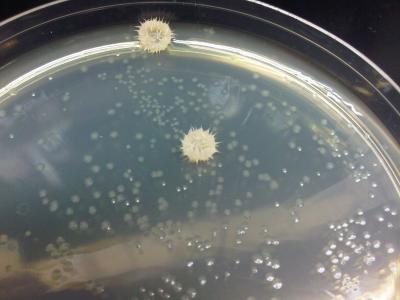
The bacteria (Escherichia coli) are the boring, flat colonies on the plate.
Those spiky fellows, I have no idea what they are. Can only assume they're some kind of fungus/mold, as the plate (and another one like it which also had one spiky dude) contains chloramphenicol (a rather robust antibiotic). Our lab also works with Pseudomonas aeruginosa (which happens to be chloramphenicol-resistant by nature), but it grows nothing like that.
I'm still trying to find a decent guide to do a taxonomical identification of these guys. Usually our contaminating buddies look more like this:
[link=http://www.flickr.com/photos/jcbaxter/2370266286/][img=http://farm4.static.flickr.com/3050/2370266286_a8b559c6c7.jpg][/link]
Argh, that worked horribly. We're just going to do this the old-fashioned way (I hope).
[link=http://www.flickr.com/photos/jcbaxter/2370266286/][/link]
Might have found an ID on whatever that spiky thing was: Lycoperdon echinatum:::link:::
or possibly also... Lycoperdon pulcherrimum:::link:::
We don't have a microscope in the lab to really check 'em up close for confirmation, and I'm not about to try and dissect one of them just to further perpetuate whatever infestation(s) we have going on in our air-handling systems.