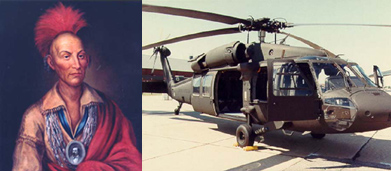
What do the Apache, Comanche, Kiowa, Iroquois, and Black Hawk all have in common? Well, they are either the names of indigenous tribes or individuals defeated by the American Army, or else they are American Army helicopters currently used to defeat other brown-skinned people who stand in the way.
Personally, the use of these names makes me sick. You can't even find a page about the real Black Hawk's war unless you search for minus Down (-down), otherwise you get pages for that big-budget Hollywood state-backed propaganda bullshit movie about Mogadishu (which, admittedly, I've never seen, but I know propaganda bullshit when I don't see it.) Or you get pages for the video game of the same name. While it is tragic to me that anyone dies in a war, we lost about 30 soldiers in that entire conflict
 while "most soldiers interviewed said that through most of the fight they fired on crowds and eventually at anyone and anything they saw" (a quote from the book the movie is supposed to be based on .)
The real issue here is how little has changed. Do we name our helicopters after defeated Indians because they were worthy opponents and fearsome warriors, or because we so successfully and thoroughly eradicated them to promote our own agenda? What myth are we trying to invoke with these names? Is the story we tell today the same as it was 200 years ago?
To counteract the myth, here's (what I think is) the real story of Black Hawk:
Black Hawk was a Sauk leader who fought on the side of the British in the War of 1812, hoping to prevent further American incursion into his native lands. The Sauk had ceded most of their territory in Illinois in a disastorous and disputed treaty with the US gov't signed in about 1804. Black Hawk and others considered the treaty null and void because they felt that the individuals who signed it did not have the authority to speak for the whole tribe. Nevertheless, the Sauks had been pushed as far west as Iowa by the 1830's, where they encountered the hostile tribes of the Lakota, Dakota, and Nakota. Caught between these warriors in the west and the encroaching settlers continually streaming from the east, the Sauk were in an increasingly comprimised position. Then, the final straw came when in 1828, President John Adams (a distant relative of mine, I should confess) sold the Sauk's Iowa lands, leaving the tribe essentially homeless. Left with little choice, Black Hawk decided to lead both the Sauk and the Fox tribes (with whom they had had an alliance since the early part of the century) back to Illinois in 1832, igniting paranoia amongst the whites who now made the new state their home.
Once in Illinois, Black Hawk faced attacks from the state militia (whose ranks included both a young Abraham Lincoln and Jefferson Davis, future prez. of the Confederacy.) Black Hawk's men were able to elude the troops for over five months, and they held out as long as they could. At one point Sauk/Fox warriors attempting to surrender were fired on by US soldiers. Finally they were defeated at the Battle of Bad Axe. Black Hawk was taken captive, and spent the rest of his life being toured around the east coast, at one point by none other than President Andrew Jackson, as if he were a curio, an exotic animal, an inanimate object.
This is what Black Hawk himself had to say (I find it so similar to what so many "beneficiaries" of our military aid would say today):
"I fought hard. But your guns were well aimed. The bullets flew like birds in the air, and whizzed by our ears like the wind through the trees in the winter. My warriors fell around me...The sun rose dim on us in the morning, and at night it sunk in a dark cloud, and looked like a ball of fire. That was the last sun that shone on Black Hawk...He is now a prisoner of the wh
it
e
men.
..He has done nothing for which an Indian ought to be ashamed. He has fought for his countrymen, the squaws and papooses, against white men, the cause of our making war. It is known to all white men. They ought to be ashamed of it. Indians are not deceitful. The white men speak bad of the Indian and look at him spitefully. But the Indian does not tell lies. Indians do not steal.
An Indian who is bad as the white men could not live in our nation; he would be put to death, and eaten up by the wolves. The white men are bad schoolmasters; they carry false books, and deal in false actions; they smile in the face of the poor Indian to cheat him; they shake them by the hand to gain their confidence, to make them drunk, to deceive them, and ruin our wives. We told them to leave us alone, and keep away from us; they followed on, and beset our paths, and they coiled themselves among us, like the snake. They poisoned us by their touch. We were not safe. We lived in danger. We were becoming like them, hypocrites and liars, adulterous lazy drones, all talkers and no workers...
The white men do not scalp the head; but they do worse-they poison the heart...Farewell, my nation!...Farewell to the Black Hawk."
(quoted in The People's History (Thanks to Terry for typing)).
(I should mention that this is Black Hawk's surrender speech...)
To find out more about the real Black Hawk, read Howard Zinn, The People's History, or check out this page, which is perhaps a bit too neutral for my taste but has a lot of primary documents, including Black Hawk's autobiography.
. It's really a site that's part of a larger Lincoln project, so they can't make the whole thing sound too bad without impugning one of our most popular presidents.Also, here is info from a .mil site on the various helicopters named after tribes: