
 mobile
Category: dance
09/07/08 03:27 - 62ºF - ID#45601
Now, you can dance like a scientologist!


Permalink: Now_you_can_dance_like_a_scientologist_.html
Words: 15
Location: Buffalo, NY


Category: goals
09/03/08 06:29 - 80ºF - ID#45551
Couldn't heft five gallons of water!!
Today morning, I drank up the last dregs of my second cuppa. To go on with the paper I was reviewing, I simply HAD TO get another cup and went to the water cooler for a refill of hot water. It was empty. As an official addict, desperation overtook annoyance and I carried a five-gallon tank of water from the storage room to the cooler. But I couldn't heft it on to the cooler! A lady I know from another division came strolling by and, in one fluid motion, hefted the five-gallon tank on to the cooler base, around four feet off the ground. I got my tea. But I am so annoyed that I let a five-gallon tank defeat me.
In my first year of school, I couldn't lift huge 15 kg watermelons. I got over this watermelon-lifting deficiency in my second year by hefting and eating an obscene number of watermelons. You might question my decision to eat all the watermelons I hefted but in my defence, I have to point out that you can't aimlessly heft watermelons all day around stores. They might kick you out or call the police, if you don't also buy them. Once you buy them, you cannot, in good conscience, let the watermelons rot, can you? Anyway the upshot of the whole thing is that the watermelon plan worked out. I don't blink an eye before grabbing even the most monstrous of watermelons nowadays.
I think the success of the watermelon plan indicates that I should perhaps start a water tank hefting plan and heft as many 5-gallon tanks as I possibly can. I reckon that my department gets through around 15 gallons (3 tanks) everyday. Just as the last drops of water are swirling down the tank and some desperate tea addict is making a sortie into the tank storage room, I need to be at hand to try out my hefting prowess and grab all the goodness of the five-gallon action at the right time.
Simple as this may sound I also foresee several logistic issues associated with the five-gallon plan. How will I know when a tank finishes? How will I make sure that I am right there to get the tank hefting practice and prevent people from doing it themselves? I know for sure that the lady who did it today will just as easily do it tomorrow. There would be no stopping her types. But I am willing to compromise and target the weak ones. If evolution worked in Galapagos island, I am sure it has a fair shot at success in Carlton Hall.
One of the options that might just solve the "how will I know" and the "right time" hurdles would be to scrawl my phone number right under the "for department use only" tag on the wall behind the cooler. I suppose the weak targets would also need an additional threatening note packed with dire consequences if they didn't call the number and attempted to replace the tank themselves.
Yeah, I think I have the five-gallon tank situation under control now. Thanks for listening. :)




Permalink: Couldn_t_heft_five_gallons_of_water_.html
Words: 580
Location: Buffalo, NY
Category: e:strip
08/31/08 01:16 - 77ºF - ID#45523
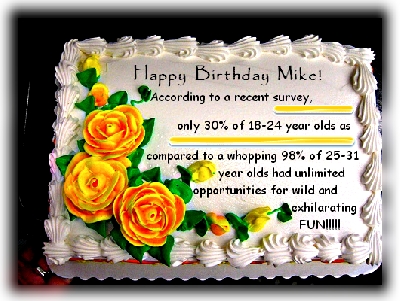
Happy Birthday, Mike! Did you know...

Permalink: Happy_Birthday_Mike_Did_you_know_.html
Words: 2
Location: Buffalo, NY
Category: carbon neutral
08/28/08 05:00 - 59ºF - ID#45487
Acrylic Sheets Disposal?
Someone in my department is re-roofing his greenhouse and would like to get rid of the old roofing responsibly - ideas anyone?



Permalink: Acrylic_Sheets_Disposal_.html
Words: 45
Location: Buffalo, NY
Category: science
08/28/08 02:45 - 66ºF - ID#45480
Remarkable Regenerative Research
Here's the direct abstract:
One goal of regenerative medicine is to instructively convert adult cells into other cell types for tissue repair and regeneration. Although isolated examples of adult cell reprogramming are known, there is no general understanding of how to turn one cell type into another in a controlled manner. Here, using a strategy of re-expressing key developmental regulators in vivo, we identify a specific combination of three transcription factors (Ngn3 (also known as Neurog3) Pdx1 and Mafa) that reprograms differentiated pancreatic exocrine cells in adult mice into cells that closely resemble beta-cells. The induced beta-cells are indistinguishable from endogenous islet beta-cells in size, shape and ultrastructure. They express genes essential for beta-cell function and can ameliorate hyperglycaemia by remodelling local vasculature and secreting insulin. This study provides an example of cellular reprogramming using defined factors in an adult organ and suggests a general paradigm for directing cell reprogramming without reversion to a pluripotent stem cell state.
It's an amazing and important breakthrough because the prevalent idea in medical research is that:
a) Cells go from an undifferentiated embryonic state to a highly differentiated specialized state.
b) Once the cells commit to a specialized state, they cannot de-differentiate or revert back into an embryonic state anymore.
c) Highly specialized cells are thus imprisoned in their narrow specialized roles and cannot convert into other specialized cells
This was the basic reason why we thought that we needed exclusively stem cells or embryonic cells from fetuses to carry out research into generating specialized cells of our choice. We believed that only embryonic cells had the potency to transform into other cells. The Harvard scientists converted a regular pancreatic exocrine cell that usually secretes digestive pancreatic enzymes to an endocrine pancreatic cell that secretes insulin! This topples the whole belief-cart that only embryonic cells can do this.
I think regenerative research officially enters a new era with this cool little cellular role-reversal trick. How these scientists did it is even more fascinating. A mere THREE regulatory genes were transported into the pancreas using small vector viruses. These viruses preferentially infected the EXOCRINE cells of the pancreas and not the endocrine cells (that are found inside "islets" of the pancreas). Within ONE MONTH, the infected exocrine cells transformed into the endocrine insulin-secreting cells and they have continued to be endocrine insulin secreting cells for a complete NINE MONTHS now!
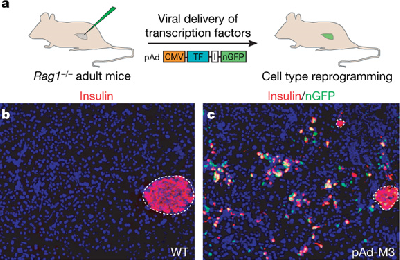
You can see the transformation in the photograph of the pancreatic tissue slice above. The red round spot is one islet (of langerhans) in the pancreas. This contains the endocrine insulin secreting cells. Within a month the same area changes to show that insulin-secreting cells have sprung up OUTSIDE the islet! One adult cell turns into another totally different adult cell!
As a simplified analogy, what they have managed to do is the cellular equivalent of turning a car (exocrine pancreatic cell) into a space-shuttle (endocrine islet cells) by just sending in three astronauts (vector-viruses) into the car to pull three levers (genes).
A couple years back, some Japanese scientists converted adult mice skin cells into stem cells but to reconvert them back into some other adult cell would have required a lot more manipulation. Considering the analogy above, it would be like converting the car into scrap metal first and then thinking about how to convert the scrap metal into the space shuttle. Do-able but yet, a step too many. This past experiment by the Japanese generated keys ideas for the Harvard group:
a) Relatively small number of genes could do the trick.
b) If the parent cell and the target cell shared a lot of common genes then maybe, just maybe the parent cell would directly convert into the target cell (and it did!).
They carefully sorted and drilled down through more than a thousand genes to finally arrive at three (Ngn3, Pdx1, and Mafa) transcription associated genes to do the transforming job.
And remember all this was done in LIVE MICE! So what happened to the mice? Some of these mice were diabetic and the additional surge of insulin from the converted cells *reduced the blood glucose levels* in these mice! Even better news was that the converted cells have stuck around for NINE months now. Nine months of blood-glucose control WITHOUT insulin injections or any other medication.
Though this research was carried out in mice, it is quite possible that it might be possible in humans as well. Some problems that the researchers are careful to point out are:
--> A vector virus was used to carry the genes inside the pancreas. What could we possibly use in humans? We cannot use a vector virus because its a LIVING organism that can potentially transform into something else infectious! The risk is just not worth it.
--> Can we use other unrelated cells to the same effect? In other words, if we need to build, say, a heart, would we need heart cells to start with or could we do with skin cells? Could these insulin-secreting cells have been generated from some other cells - other than closely related exocrine-enzyme-secreting pancreatic cells?
Till these questions are answered, we will need stem cells, embryonic cells and research using these cells (BACK OFF. GEORGE IDIOT BUSH!). We cannot just toss them in the trash. This new approach of converting one adult cell to another is very much an unknown angel. But what an awesome angel!! Their potential is mind-boggling! :)


Permalink: Remarkable_Regenerative_Research.html
Words: 946
Location: Buffalo, NY
Category: i-tech
08/24/08 11:18 - 71ºF - ID#45444
The OpenID Future Webscape
 as my OpenID delegate. I was somewhat surprised by the extremely elaborate and somewhat outlandish hoops of security they made me jump through, to register an OpenID. It was fun in a bizarre way.
 First, they throw the standard registration questions at you.
Username:
Password:
DOB:
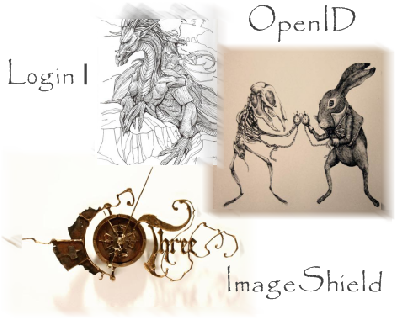
After you answer those, they take you to a panel of 12 image concepts called the ImageShield*, that looks like this:

You select three image concepts that serve as your "secret question". In future logins, the site would present the imageshield and to login successfully, you would need to spot and type in the codes that appear on your previously chosen image concepts. The images and codes change, but the concept of the image stays the same. For eg. the imageshield will always have a picture of a bird or birds associated with the concept of a "bird" and a picture of some automobile associated with the concept of a "car" etc.
I think the idea of an OpenID is, in itself, an interesting experiment in online security. The imageshield at vidoop makes it seem even more futuristic. Someday, we will all be Neos and Trinitys of the online world and our password to virtual space will be a unique personal combination of the white rabbit, our own demons and perhaps a dilated concept of time.
Identity thefts would either be a thing of the past or identity thieves would have caught up to the technology and have succeeded in scanning minds of passers-by to mine information about their guarded mindscapes. For now, OpenIDs are just a weirdly cool way of shouting out your virtual name from digital rooftops to a pixelated universe.
______________
The De-Jargon/De-Geek Zone
(formerly known as the footnote):
- What is OpenID: OpenID is a shared identity service, which allows Internet users to log on to many different web sites using a single digital identity, eliminating the need for a different user name and password for each site. OpenID is a decentralized, free and open standard that lets users control the amount of personal information they provide.
More information here:
a) What is OpenID:
b) Wiki for OpenID:
c) *ImageShield:
Permalink: The_OpenID_Future_Webscape.html
Words: 398
Location: Buffalo, NY
Category: eating in
08/23/08 08:08 - 84ºF - ID#45425
Lunch Picture Post
1. Appetizer: (A tiny portion of ) a HUMONGOUS pack of the most scrumptious Kettle corn - its almost as tall as I am! (The rest has been put away out of sight for the rest of the week).
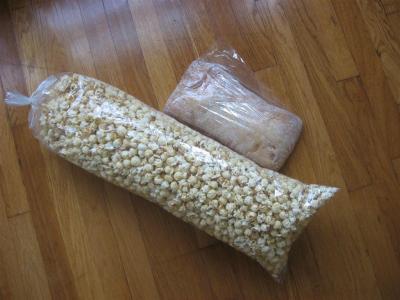
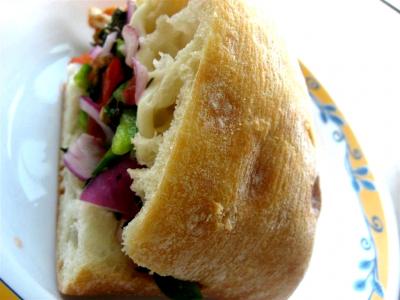
2. Main Course: Most DELICIOUS Ciabatta Bread Veggie Medley Cheese Sandwich (Ciabatta bread from Lexington - I know. I know. I boycotted the place but I went in today and gave into temptation. They were just rolling this off the oven!)
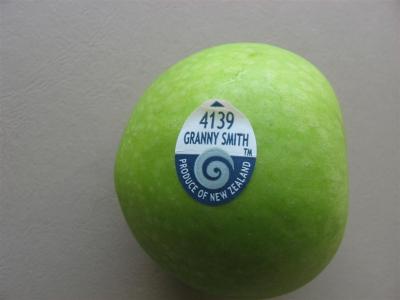
3. Dessert: A Granny Smith all the way from New Zealand. Talk about a Godzilla like carbon footprint! :(
4. Contemplation: A steaming cuppa Mango tea with milk.
(Not pictured. I drank it up before I realized I hadn't photographed it! This is a view out my flat window, instead.)

Have an awesome evenin'!
Permalink: Lunch_Picture_Post.html
Words: 151
Location: Buffalo, NY
Category: opinion
08/22/08 07:07 - 87ºF - ID#45414
Some questions for everyone.
If your neighbour is quiet and non-intrusive, you don't care if he is cheating on his wife and doing "injustice" to his kids. You mind your own business. If your politician is doing his job, why should you not give him the same respect and non-censure? You could argue that his affairs might be used to blackmail him but of what use would a blackmail be if the public didn't care? What if we only cared about our politicians performing their jobs? Don't you think enough damage has been done not only to this country but millions abroad, by impeaching a relatively nice non-warring president over his personal affairs?
Even if your politician is not doing his job, is there any reason to dig up dirt on his personal life and mix it in with his performance on his job? Does your boss add a line on your annual performance report about your sexual partners and your affairs? Does your boss even care about your affairs if you do your job (or don't do your job)?
You could make a valid bitter case and complain if an extra-marital affair of any politician affected his performance of his job. Last I checked, politicians are not generally elected because they are a moral example. I don't see why affairs should even make it into any news source other than lurid tabloids that exist for such details. How is being a "moral (or even mortal) messenger" any different than being the paparazzi that hounded Diana to her death?

Permalink: Some_questions_for_everyone_.html
Words: 271
Location: Buffalo, NY
Category: science
08/22/08 07:37 - 66ºF - ID#45407
What if we were all little people? - II
Big leg bones from the Indonesian island of Flores show that the meter-high "hobbit" people (Homo floresiensis) who once lived there shared the island with enormous flesh-eating storks, researchers say.
Hanneke Meijer of the National Museum of Natural History in Leiden, the Netherlands, and Rokus Awe Due of the Indonesian Centre for Archaeology in Jakarta found the bones in Liang Bua cave in the same layers as the hobbits--dated to at least 18,000 years ago. They identified them as a new species of extinct giant marabou. The scientists say the 1.8-meter-tall bird was a carnivore and top predator on the island; whether hobbits were among its fare is open to speculation. They reported on the find this week at the meeting of the Society of Avian Paleontology and Evolution in Sydney, Australia.
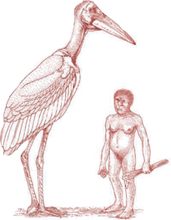
So (e:carolinian)'s guess is probably more closer to truth than we'll ever know! The little people did exist at one point. Their extinction points to the fact that they were probably not very evolutionarily stable. Yeah, we were biologically fated to have kitchens with 9 - 10 foot (or higher) ceilings and similarly scaled counters and appliances.

Permalink: What_if_we_were_all_little_people_II.html
Words: 212
Location: Buffalo, NY
Category: e:strip
08/19/08 05:28 - 68ºF - ID#45367
Clicked "View Source" & what did I see?

Permalink: Clicked_quot_View_Source_quot_amp_what_did_I_see_.html
Words: 10
Location: Buffalo, NY
Author Info

Date Cloud
- 12/21
- 12/15
- 02/15
- 01/15
- 11/14
- 08/14
- 04/14
- 02/14
- 11/13
- 07/13
- 09/12
- 08/12
- 07/12
- 04/12
- 03/12
- 02/12
- 01/12
- 12/11
- 11/11
- 10/11
- 09/11
- 08/11
- 07/11
- 06/11
- 05/11
- 04/11
- 03/11
- 02/11
- 01/11
- 12/10
- 11/10
- 10/10
- 09/10
- 08/10
- 07/10
- 06/10
- 05/10
- 04/10
- 03/10
- 02/10
- 01/10
- 12/09
- 11/09
- 10/09
- 09/09
- 08/09
- 07/09
- 06/09
- 05/09
- 04/09
- 03/09
- 02/09
- 01/09
- 12/08
- 11/08
- 10/08
- 09/08
- 08/08
- 07/08
- 06/08
- 05/08
- 04/08
- 12/07
- 11/07
- 10/07
- 09/07
- 08/07
- 07/07
- 06/07
- 05/07
- 04/07
Category Cloud
More Entries
After This
My Fav Posts
- Click the heart at the bottom of anyone's blog entry to add it here ;(
 Buffalo Pride weekend marathon
 Raggedy Annie Plushapalooza '96
